
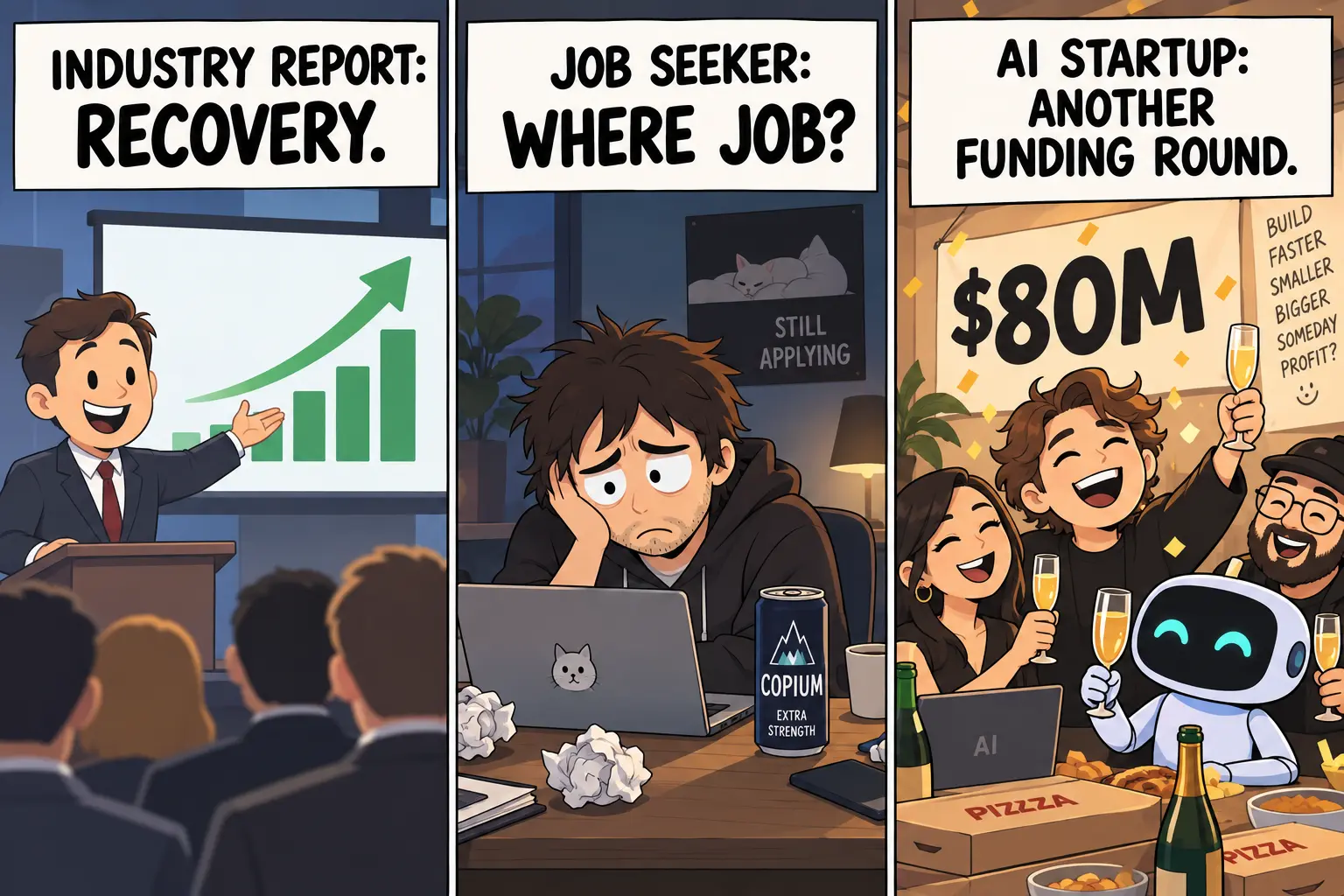
Oh brother, the tech job market is weird right now. For example, TechSverige counted 7,900 openings in the tech industry in the first quarter of 2026, 40% fewer than a year earlier. Over the preceding twelve months, about 8,200 new tech companies were started, 32% more than the year before.1
Tech openings: ↓ 40%  🥲
New tech firms: ↑ 32%  🥳
Those figures cover different periods, and they don't tell us who started those companies or how many people they employ. But they capture the strange feeling: the industry can show signs of life while the job market still feels terrible.
The Demand Is Moving
TechSverige also looked at AI-related words in Swedish job ads. Their occurrences increased by just over 200% between 2024 and 2025. In 2025, they counted 8,157 occurrences across 177 occupational groups, up from 625 occurrences across 46 groups in 2016.2
That's a count of keywords, not a count of AI jobs or companies. It covers all occupations in 2025, while the openings figure covers the tech industry in early 2026. Ads mentioning AI are still a small share of all ads. Even so, the change suggests that what employers ask for is shifting quickly.
And then you look at the extreme end of the market. Swedish-founded Lovable said it reached $200 million in annual recurring revenue one year after launch. In August 2026, it announced a $400 million funding round at a $13.3 billion valuation. Legora, another Swedish-founded AI company, reached $100 million in annual recurring revenue in 18 months, according to investor Bessemer.34
These company-reported revenue figures and funding rounds don't measure hiring. They do show how much growth and capital can gather in a few places while the broader job market struggles. It is quite a picture:
Do Smaller Companies Mean Fewer Jobs?
In my last article, I argued that AI may let people start useful businesses with smaller teams. There is some early evidence consistent with that idea. In a US analysis of Gusto payroll data, firms founded in 2024 in information and professional services had about 6% fewer employees after twelve months than comparable firms founded in 2023.5
But that isn't the only possible path. In a separate Gusto analysis, small businesses that adopted AI had about 7% higher headcount after a year than businesses that knew about AI but hadn't adopted it. The difference was larger among firms with fewer than ten employees.6
The studies follow different groups of US businesses, and both are observational. They don't show that AI caused either result, or that a business starts small and then necessarily hires later. They do make room for two things to be true: some firms may need fewer people to get started, while others may use time saved to serve more customers and eventually add people.
That's why a rise in new companies doesn't automatically replace the missing job openings. Those firms still need customers, and a new business with one founder is not the same thing as an open position for someone else.
So, Who Took Our Jobs?
I don't think there is one tidy culprit hiding behind the numbers. TechSverige describes cautious hiring after an economic downturn, alongside rapid technological change. The Swedish figures show growth, new firms, fewer openings, and changing demand at the same time. They don't tell us how much of the hiring slowdown AI caused.1
For anyone looking for work, that distinction doesn't make the search easier. A market can be growing in one corner and painfully quiet in another. For leaders, the useful question is what happens to the time and money these tools save: do you serve more customers, build something new, hire for different work, or simply try to do the same work with fewer people? I suspect we'll see all of those choices. 😅
Okay, But How Do You Stand Out?
None of this helps much when you're staring at another rejection email. But you can make your work easier to recognize.
Make the match obvious. Tailor your CV to the role, use its language where it honestly fits your experience, and keep it easy to scan. Robert Half recommends this approach; Swedish recruiter TNG says clarity and relevance matter more than elaborate "AI optimization" when people make the initial selection.78
Then show depth, ownership and impact: what did you understand, what did you own, and what changed? That's how Robert Half advises tech employers to evaluate candidates.9 For software roles, a focused portfolio can show work that a CV only describes. TNG says case interviews also let employers see how you reason, prioritize and communicate.1011
Use AI to sharpen your application, but don't become CandidateGPT. 😅 TNG says recruiters see near-identical AI-generated texts, so keep the examples and substance your own.8 Keep your LinkedIn profile clear and current, too: recruiters search there for relevant experience.12
If you're working on the CV part, I built CV Linter. It's an open-source tool that checks PDF, DOCX, and Markdown CVs locally for structure, formatting, text extraction, and spelling issues. It gives you concrete findings to fix before you apply.
None of this creates openings. It makes your work easier to see in a noisy market.
Footnotes
-
TechSverige's September 2026 summary and full Tech Temperature report (PDF). Openings cover Q1 2026, while new firms cover the preceding twelve months. Both use the information and communication industry (SNI 58–63), rather than all people working in tech occupations. The report traces openings to Statistics Sweden and company formation to the Swedish Agency for Growth Policy Analysis. It also finds that survey-based tech employment rose 4.3% in the first half of 2026, driven mainly by more business owners; the number of employees rose 0.6%. ↩ ↩2
-
TechSverige's June 2026 analysis and its underlying job-ad summary (PDF). Across 7.3 million Swedish job ads from 2016–2025, 23,025 contained at least one AI-related keyword. The reported 8,157 figure counts keyword occurrences in 2025, not distinct vacancies requiring AI skills. ↩
-
Lovable, “One year of Lovable”, November 18, 2025; Lovable, Series C announcement, August 12, 2026. ARR is a company-reported run rate, not employment. ↩
-
Bessemer Venture Partners on Legora's ARR, April 1, 2026. Bessemer is an investor. For hiring context, Legora reported in March 2026 that its team had grown from 40 to 400 people over the previous year, across six cities; rapid revenue growth there did involve hiring. ↩
-
Gusto, “Leaner Startups, More Founders”, April 23, 2026. The payroll comparison covers firms in information and professional services founded in 2023 and 2024 and cannot establish that AI caused the difference. In a separate 2026 survey of 1,051 founders, half said AI made launching faster or cheaper, while only 3% said they likely would not have started without it. These are US findings and cannot explain why the Swedish firm count rose. ↩
-
Gusto's September 2026 payroll follow-up to its 2025 small-business AI survey. The follow-up compares 1,593 AI adopters with 669 businesses aware of AI that had not adopted it, all Gusto customers who answered the survey. It describes an association, not a causal effect or a representative sample of all US small businesses. ↩
-
Robert Half, “Technology career paths, skills and job search strategies for 2026”. US recruiter guidance recommends tailoring a scannable CV to the role and showing applied experience, rather than merely listing tools. ↩
-
TNG, “AI i jobbansökan – do’s and don’ts från rekryteraren”, updated July 2026. TNG says human recruiters usually make the initial selection in Sweden and warns that generic AI-written applications obscure a candidate's actual experience. This is TNG's recruiting perspective. ↩ ↩2
-
Robert Half, “AI in the hiring process: How employers can recruit tech talent with more confidence”. Its suggested evaluation framework asks employers to check a candidate's depth, ownership and impact; it is guidance, not evidence that every employer uses this rubric. ↩
-
Indeed Editorial Team, “How To Create a Software Engineer Portfolio in 6 Steps”, updated June 2026. This is advice for software engineers on showing projects and their own contributions, not a measured hiring outcome. ↩
-
TNG, “Caseintervjuer inom rekrytering – vad, hur och varför?”, June 2026. TNG describes using realistic scenarios in technical hiring to see how candidates reason, prioritize and communicate. ↩
-
TNG, “Så ökar du chansen att bli kontaktad av en rekryterare på LinkedIn”, updated July 2026. The recruiter advises keeping role, skills, work history and examples visible and current so candidates can be found through search. ↩