Recently I've been reading a lot about AI – Well, you can't even avoid it these days – and its organizational impact, which doesn't get talked about much. Some of it went into my last article about the productivity chase; the rest has me thinking about a different question:
Why do small organizations go brrr while much bigger organizations struggle?
If you don't know what goes brrr means, it's a 2020 meme about a money printer making a "brrr" sound as it prints huge amounts of money. Meme lesson over. 🤣
So I don't mean that a company of one can now magically print money. I mean the smallest useful organization may be getting smaller, while the cost of coordinating people and work is still there, and might actually be getting worse with the Slop Grenades™.
The Minimum Viable Organization Is Shrinking
A founder can now get help from AI without hiring a specialist for every job. The quality varies, of course, but so does the quality of human work. The tools still need direction and vision from someone who understands what the business is trying to do. But the access to knowledge and skills is an incredible improvement for small organizations.

Imagine you run a small bakery with customers in a local market. Now you can use AI agents to help with things you couldn't do before, like social media, research, website development, design, and SEO.
There is already a gap between individual productivity and the value companies say they are capturing. In McKinsey's 2026 survey, eight in ten respondents said AI improved their personal productivity, while 37% said it had contributed to their organization's earnings.1
The ILO calls this the "aggregation paradox": studies often find meaningful productivity gains on individual tasks, but those gains have not yet appeared clearly in firm-level or economy-wide productivity data. They don't automatically add up. Adoption, work redesign, skills, and how productivity is measured all affect whether local gains scale.2
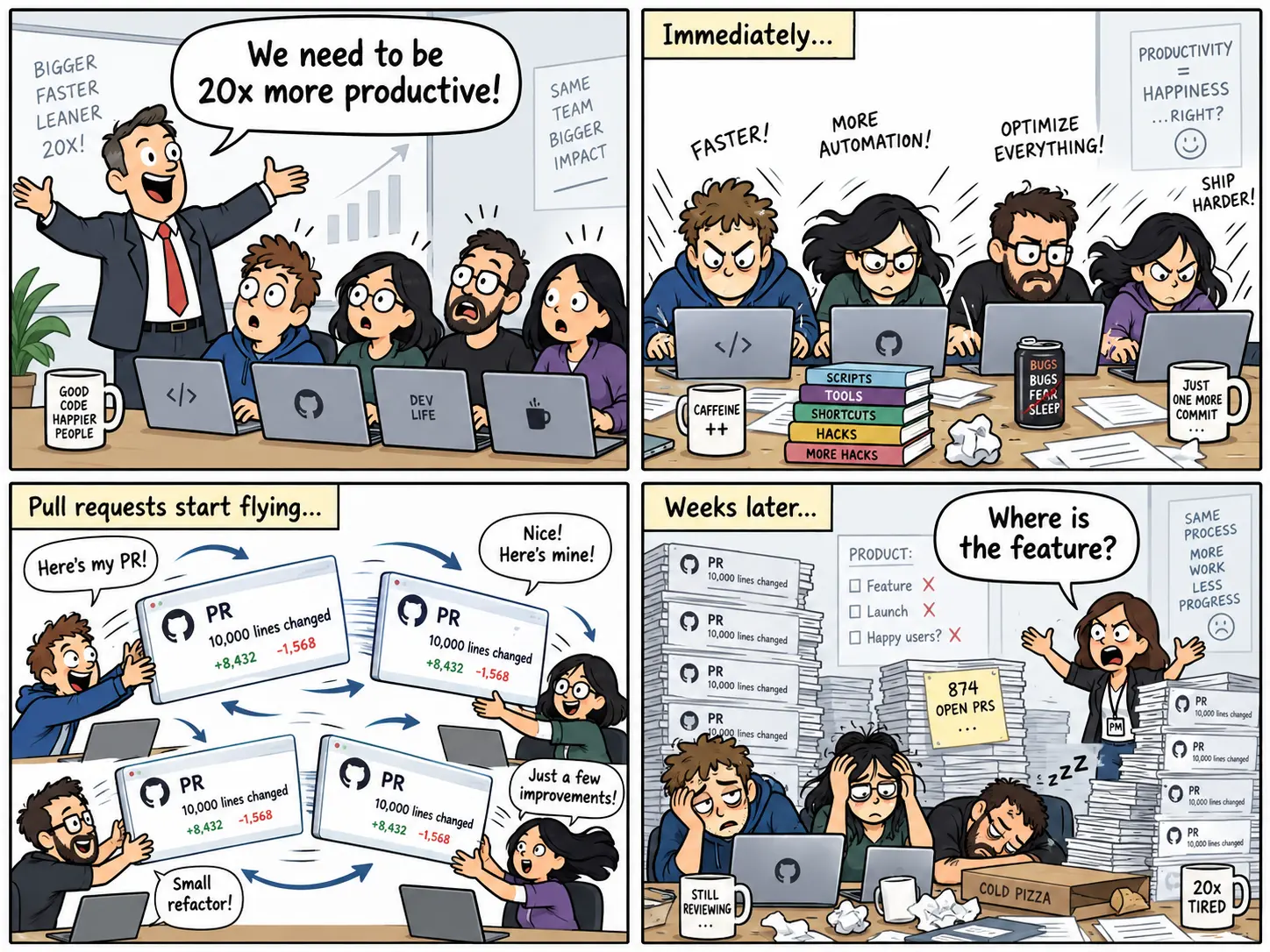
AI doesn't automatically make the whole organization faster at deciding what matters, coordinating the work, checking the result, or getting it to customers. I wrote about the engineering version of this in “So Everyone is a 10x Product Engineer. Now What?”.
B2B Software Needs a Stronger Moat
Enterprise customers are experimenting with agents connected to internal data and business systems. That means data access, APIs, permissions, and workflow logic become part of the product problem, alongside the model itself.3
McKinsey reports that 32% of survey respondents said their organization had passed on at least one software purchase because it could build the functionality in-house with coding agents. Gartner estimates that about 20% of enterprise application SaaS spending could be exposed to agentic AI by 2030.4
This doesn't mean B2B software disappears. It means people want MCPs to connect their software to AI agents. So you should start thinking about an AI Interface as well as a user interface (I coined the term just now 🤣).
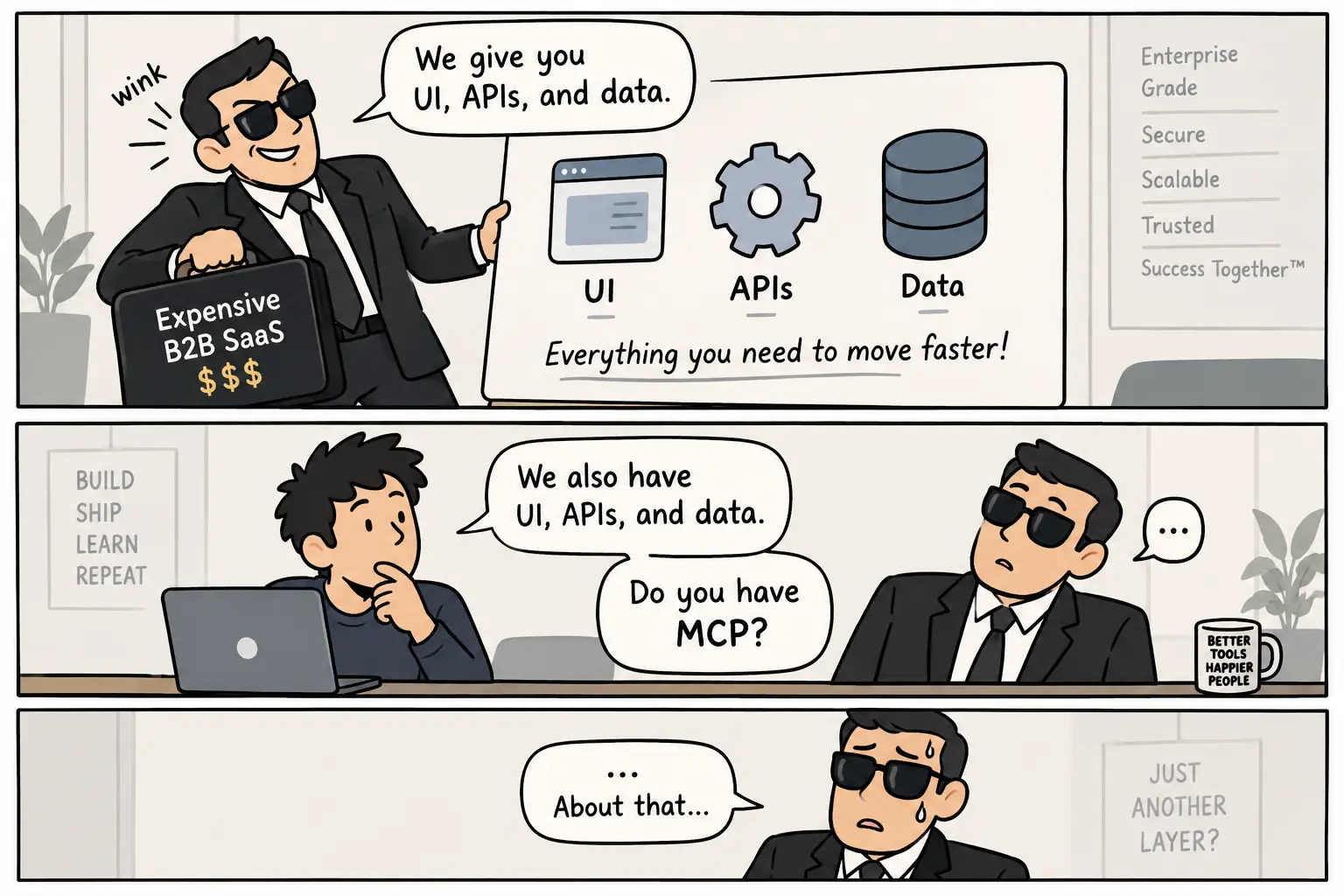
The harder things to replace are likely to be trusted systems of record, proprietary data, deep integrations, domain expertise, reliability, and the rules that keep important work safe and auditable. Data helps, but "we have data" by itself isn't a moat.
Then There's the Power Bill
As competition in frontier AI ramps up and demand for data centers and compute skyrockets, we shouldn't overlook the power bill. The IEA projects that data-center electricity use will nearly double from 2025 to 2030, while electricity use from AI-focused data centers triples. It says grid capacity is already a critical bottleneck in many regions, with more than 2,500 GW of renewable, large-load, and storage projects stalled in grid queues worldwide.5
That doesn't mean the grid is the only constraint, but if the price of power goes up, so does everything else. Organizations should keep an eye on energy prices; otherwise, they might end up on the wrong side of a big rug pull.
And The Economy Balances Itself
The economy naturally tends toward an economic equilibrium where supply meets demand over the long run. My guess is that AI makes it viable to start and operate more businesses with smaller teams. They could grow and attract workers, while bigger firms could get smaller and focus on core competencies.
Results may vary! 😂 The small firm still has to find customers. The big firm still has to adapt how work gets coordinated. And a person with ten AI tools still needs judgment about what to build and whether the result is any good.
So yes, I think the minimum viable organization is shrinking, but I also think the future is too volatile to even attempt to predict. We have to learn how to go with the flow. 😎
Footnotes
-
McKinsey, “The State of AI: Global Survey 2026”. These are respondents' reported experiences, not a direct measurement of productivity or earnings caused by AI. ↩
-
International Labour Organization, “The Aggregation Paradox of AI: Why do micro-economic productivity gains from AI disappear at scale?”. Published May 6, 2026, the brief examines why task-level productivity gains have not yet translated into clear firm- or economy-wide gains. ↩
-
McKinsey, “Building the Foundations for Agentic AI at Scale”. The report discusses data quality, interoperability, governance, identity, and permissions as requirements for reliable agent workflows. ↩
-
McKinsey, “The State of AI: Global Survey 2026” and Gartner, “$234 Billion in Enterprise Application Software Spend Is at Risk from Agentic AI”. Gartner's figure is a forecast of spending exposed to disruption, not a prediction that this amount will disappear. ↩
-
IEA, “Key Questions on Energy and AI” and IEA, “Electricity 2026: Grids”. The grid queue figure includes renewable, large-load, and storage projects; it is not a count of data centers alone. ↩