For the full immersive experience, the theme song is here
The Chase for Productivity Is Real
By now, you've probably heard about the AI-first strategies and 10x productivity plans from leaders. I bet you're working toward a future where AI is the default way to build software. But how do you get there? How do you scale it across your organization?
Shopify, Duolingo, Fiverr, Meta, and others have publicly pushed AI-first strategies or expectations around employee AI use. Shopify famously went as far as requiring teams to demonstrate why AI couldn't accomplish work before asking for additional headcount.1
And here's a fascinating development from literally four days ago: Shopify CEO Tobi Lütke is now warning about what he calls "slop grenades"—employees using AI to produce large amounts of poorly considered work that then becomes somebody else's PR review nightmare. Shopify hasn't backed away from AI; Lütke says its internal agent may now handle as much as half of production-code PRs. It raises the question: "What happens to the rest of the organization when producing work becomes extremely cheap?"2
McKinsey's August 2026 survey shows the technology itself is already moving rapidly into organizations: 40% of respondents at large enterprises report scaling AI agents, and about 31% report scaling coding agents.3
On September 9, 2026, McKinsey published research specifically about AI and the operating model. Its conclusion is basically this:
Agentic AI requires organizations to rethink how work gets done, decisions are made, capabilities are developed, and value is created.
They explicitly argue there isn't one established "best" AI operating model yet.4
Deloitte's June 2026 study gives us the killer statistic:
Among 660+ technology executives, 81% said they could deploy and govern AI at scale today, while nearly 75% said their operating model would need to change within 12–18 months.
Deloitte literally calls this a "structural readiness gap."5 This is really an operating model problem.
You want adoption? YOU GET ADOPTION!
Companies are adopting AI much faster than they're redesigning work. Another 2026 Deloitte study says only 34% of organizations are truly reimagining the business around AI. More tellingly, companies have mostly responded to AI's workforce implications through training and AI fluency rather than redesigning roles and workflows. And only one in five organizations reports having mature governance for autonomous AI agents.6
Publicis Sapient's June survey of 1,550 AI decision-makers gives us another angle: 73% say AI is used regularly or across most business processes, but only 10% say AI is core to how the business actually operates.7
Well, we are in the messy middle of this AI adoption journey. Companies are figuring out how to drive AI adoption, and if you're in a churning business, that's a perfect recipe for mistakes.
Churn > Fast Decisions > AI-First > 20x Code > Layoffs > Too Many PRs > Rehiring
And guys, guys, listen: giving everyone Claude/Copilot/Codex isn't an operating model. 🤣
"Why Are Our Experienced Engineers Frustrated?"
DORA has almost hilariously perfect evidence. Their recent analysis says AI accelerates initial code generation, but engineers frequently spend part of the saved time on auditing and verification. They call this the "verification tax."8
Even better, their qualitative research explicitly identifies code review as a shifting burden. Individual developers can generate much larger changes faster, while reviewers still need to understand and verify the output. DORA reports higher AI adoption alongside both higher throughput and higher delivery instability.
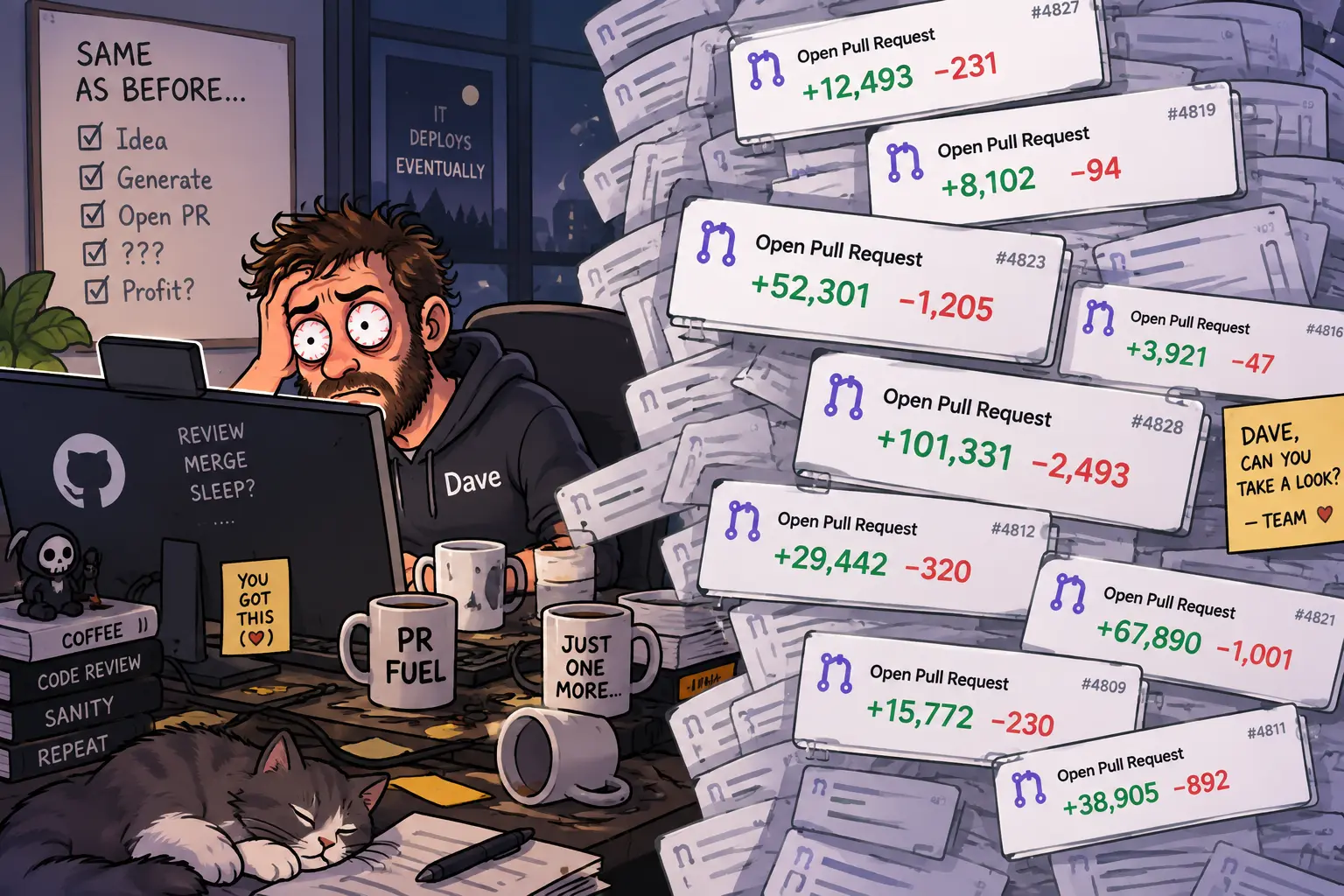
The Operating Model Has To Change
And the funniest part is that management has spent ~15 years with a fairly comfortable library of answers:
Agile. Scrum. DevOps. Product teams. Platform engineering. CI/CD. UX research. Two-pizza teams. Spotify model. SAFe if you've committed some terrible sin in a previous life. 🤣
But now someone asks:
"How should a company operate when every employee has multiple semi-autonomous cognitive agents?"
Answer: 🤷
McKinsey says there isn't one best model yet, so we're genuinely in that experimentation period.4
Well, I have some ideas, check out my other article about AI Federations here. Until then, take care of yourselves, and don't get too caught up in the hype tornado. 😎