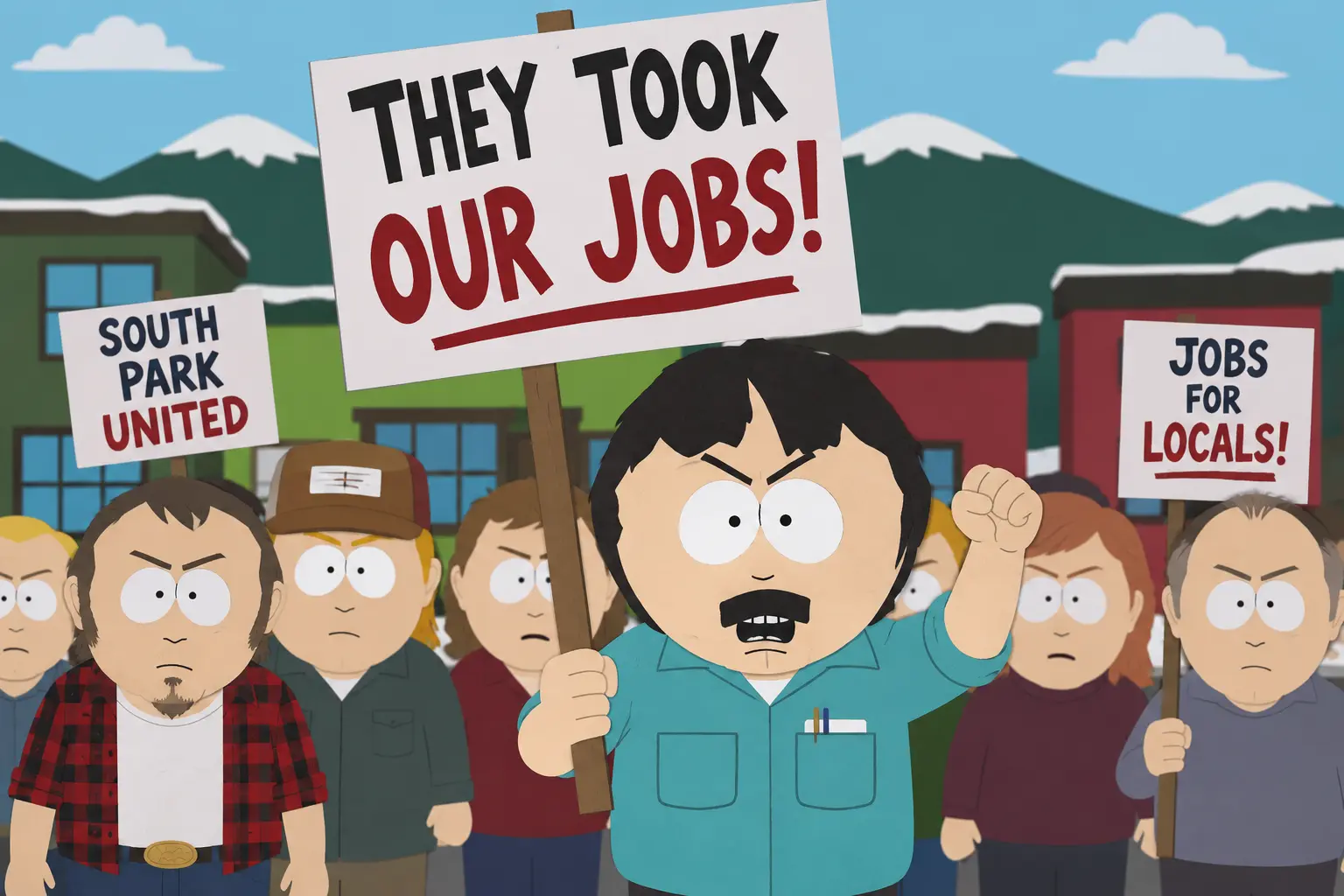
Oh brother, the tech job market is weird right now. For example, TechSverige counted 7,900 openings in the tech industry in the first quarter of 2026, 40% fewer than a year earlier. Over the preceding twelve months, about 8,200 new tech companies were started, 32% more than the year before.1
Tech openings:  ↓ 40%  🥲
New tech firms: ↑ 32%  🥳
Those figures cover different periods, and they don't tell us who started those companies or how many people they employ. But they capture the strange feeling: the industry can show signs of life while the job market still feels terrible.
The Demand Is Moving
TechSverige also looked at AI-related words in Swedish job ads. Their occurrences increased by just over 200% between 2024 and 2025. In 2025, they counted 8,157 occurrences across 177 occupational groups, up from 625 occurrences across 46 groups in 2016.2
That's a count of keywords, not a count of AI jobs or companies. It covers all occupations in 2025, while the openings figure covers the tech industry in early 2026. Ads mentioning AI are still a small share of all ads. Even so, the change suggests that what employers ask for is shifting quickly.
And then you look at the extreme end of the market. Swedish-founded Lovable said it reached $200 million in annual recurring revenue one year after launch. In August 2026, it announced a $400 million funding round at a $13.3 billion valuation. Legora, another Swedish-founded AI company, reached $100 million in annual recurring revenue in 18 months, according to investor Bessemer.34
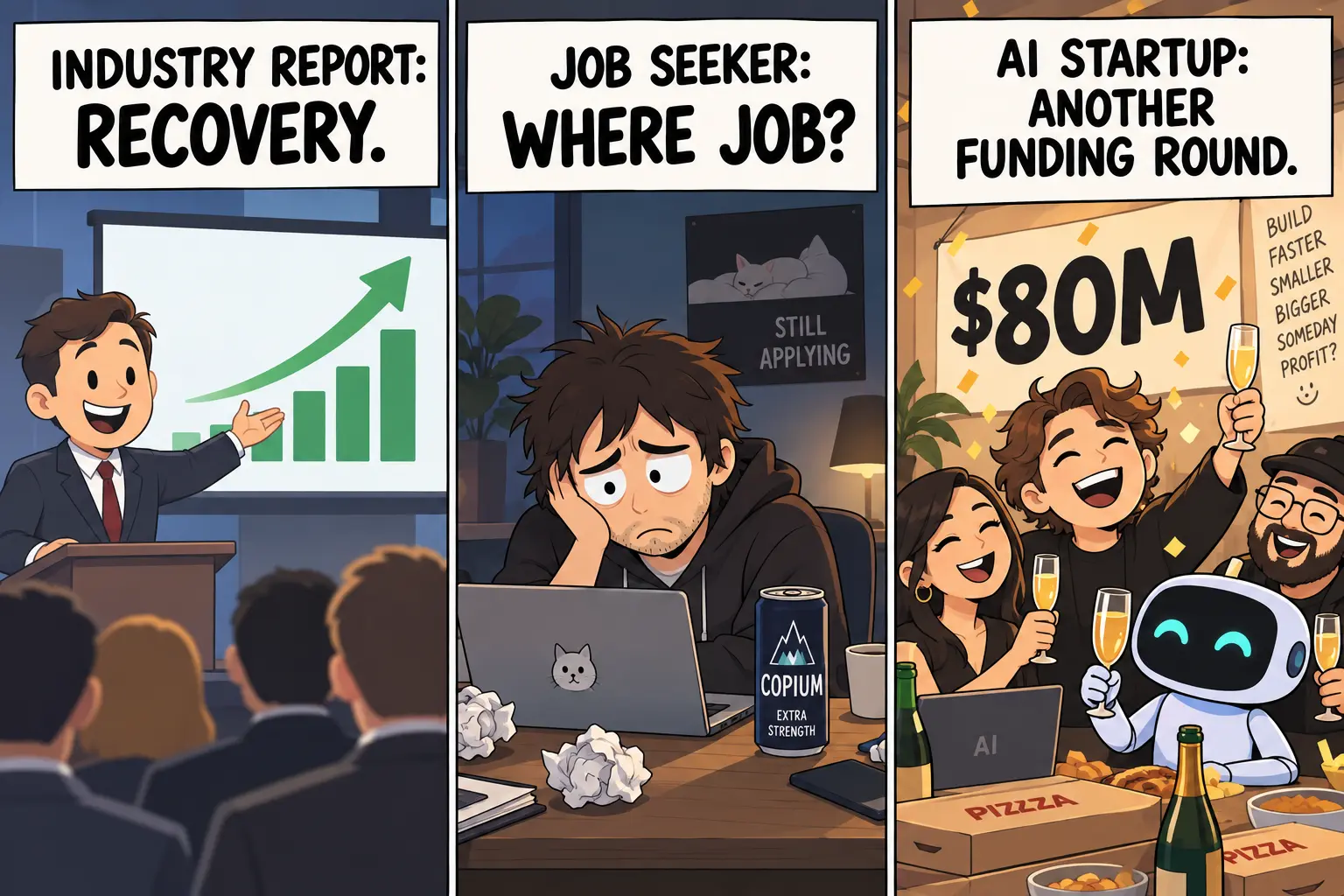
These company-reported revenue figures and funding rounds don't measure hiring. They do show how much growth and capital can gather in a few places while the broader job market struggles. It is quite a picture:
So, Who Took Our Jobs?
I don't think there is one tidy culprit hiding behind the numbers. TechSverige describes cautious hiring after an economic downturn, alongside rapid technological change. The Swedish figures show growth, new firms, fewer openings, and changing demand at the same time. They don't tell us how much of the hiring slowdown AI caused.1
For anyone looking for work, that distinction doesn't make the search easier. A market can be growing in one corner and painfully quiet in another. For leaders, the useful question is what happens to the time and money these tools save: do you serve more customers, build something new, hire for different work, or simply try to do the same work with fewer people? I suspect we'll see all of those choices. 😅
Pencils Down, Pencils Up
On September 23, Ruby on Rails creator David Heinemeier Hansson (DHH) opened Rails World by announcing that his company, 37signals, has gone "pencils down": agents now write the code, and writing it by hand is the exception. His argument was blunt: for most programmers at most companies, writing code by hand no longer makes economic sense.5
Not everyone was cheering. One viewer called the keynote "the most confusing funeral I've ever experienced."6 I get it. Many of us chose this job because we love writing code, and handing it to an agent can feel like losing the best part of the work. If that's you, your job satisfaction may be taking a hit. But look at the alternative: with tech openings down 40%, walking away from these tools isn't a comfortable option for most people. My take is that it's better to adapt. As the job ads show, what employers ask for is already shifting toward AI.
Here's the strange part, though: interviews haven't caught up. In a January 2026 Karat survey of 400 engineering leaders in the US, India and China, 62% of organizations still prohibited AI in technical interviews, and 71% of the leaders said AI is making technical skills harder to assess.7 AI-assisted cheating has pushed some employers the other way: in 2025, Google, Cisco and McKinsey brought back in-person interviews for some candidates.8
So you may be hired for how well you write code by hand, then asked to design solutions, direct agents and review what they produce. I suspect the process even favors the people who love writing code the most, then hands them a job with less of it.
To be fair, fundamentals still matter. You can't review code you don't understand, and agents will happily produce a lot of it. The mismatch is the format: many interviews still ask you to write code with your usual tools taken away, while the job asks you to use those tools well.
Okay, But How Do You Stand Out?
None of this helps much when you're staring at another rejection email. But you can make your work easier to recognize.
Make the match obvious. Tailor your CV to the role, use its language where it honestly fits your experience, and keep it easy to scan. Robert Half recommends this approach; Swedish recruiter TNG says clarity and relevance matter more than elaborate "AI optimization" when people make the initial selection.910
Then show depth, ownership and impact: what did you understand, what did you own, and what changed? That's how Robert Half advises tech employers to evaluate candidates.11 For software roles, a focused portfolio can show work that a CV only describes. TNG says case interviews also let employers see how you reason, prioritize and communicate.1213
Until interviews catch up, prepare for both sides of the mismatch. Keep your coding fundamentals sharp, because many interviews will still test them without AI. Then use your portfolio, case interviews and examples to show the design, judgment and ownership that agent-heavy work needs.
Use AI to sharpen your application, but don't become CandidateGPT. 😅 TNG says recruiters see near-identical AI-generated texts, so keep the examples and substance your own.10 Keep your LinkedIn profile clear and current, too: recruiters search there for relevant experience.14
If you're working on the CV part, I built CV Linter. It's an open-source tool that checks PDF, DOCX, and Markdown CVs locally for structure, formatting, text extraction, and spelling issues. It gives you concrete findings to fix before you apply.
None of this creates openings. It makes your work easier to see in a noisy market.
Footnotes
-
TechSverige, Tech Temperature, September 2026 (full report, PDF). Both figures cover the information and communication industry (SNI 58–63). ↩ ↩2
-
TechSverige, AI skills in job ads (in Swedish), June 2026 (PDF). ↩
-
Lovable, “One year of Lovable”, November 2025, and Series C announcement, August 2026. ↩
-
Bessemer Venture Partners, April 2026. ↩
-
DHH's Rails World 2026 opening keynote, as reported by Startup Fortune. ↩
-
A viewer comment quoted by Global Nerdy, September 2026. ↩
-
Karat, “Engineering Interviews in 2026”, January 2026. Karat sells technical interviewing services. ↩
-
Computerworld, August 2025. ↩
-
TNG, AI in job applications (in Swedish), July 2026. ↩ ↩2
-
Indeed, software engineer portfolio guide, June 2026. ↩
-
TNG, case interviews in recruiting (in Swedish), June 2026. ↩
-
TNG, LinkedIn profile tips (in Swedish), July 2026. ↩