
Hello everybody, I recently wrote about running mixture-of-experts models locally, even joked about "having MoE at home", squeezing increasingly capable AI into consumer hardware. Quantization, CPU offloading, clever inference engines, and enough patience to watch a model generate five tokens per second.
It turns out not everyone can afford the hardware to run LLMs locally. Prices are off the charts.
Forget bitcoin, forget crypto, forget the stock market. If you had invested in RAM, you'd make 5-6x your investment. 😎
So, what's the deal?
Show me the money!
Let's look at the numbers.
In Sweden, SweClockers tracks a fixed basket of eight 32GB DDR5 memory kits. As of October 20, 2026, the median price is 7,507 SEK. Its index has roughly quintupled over the past year.1
Excuse me, sir? Is this 32GB of gold-plated RAM? 😭
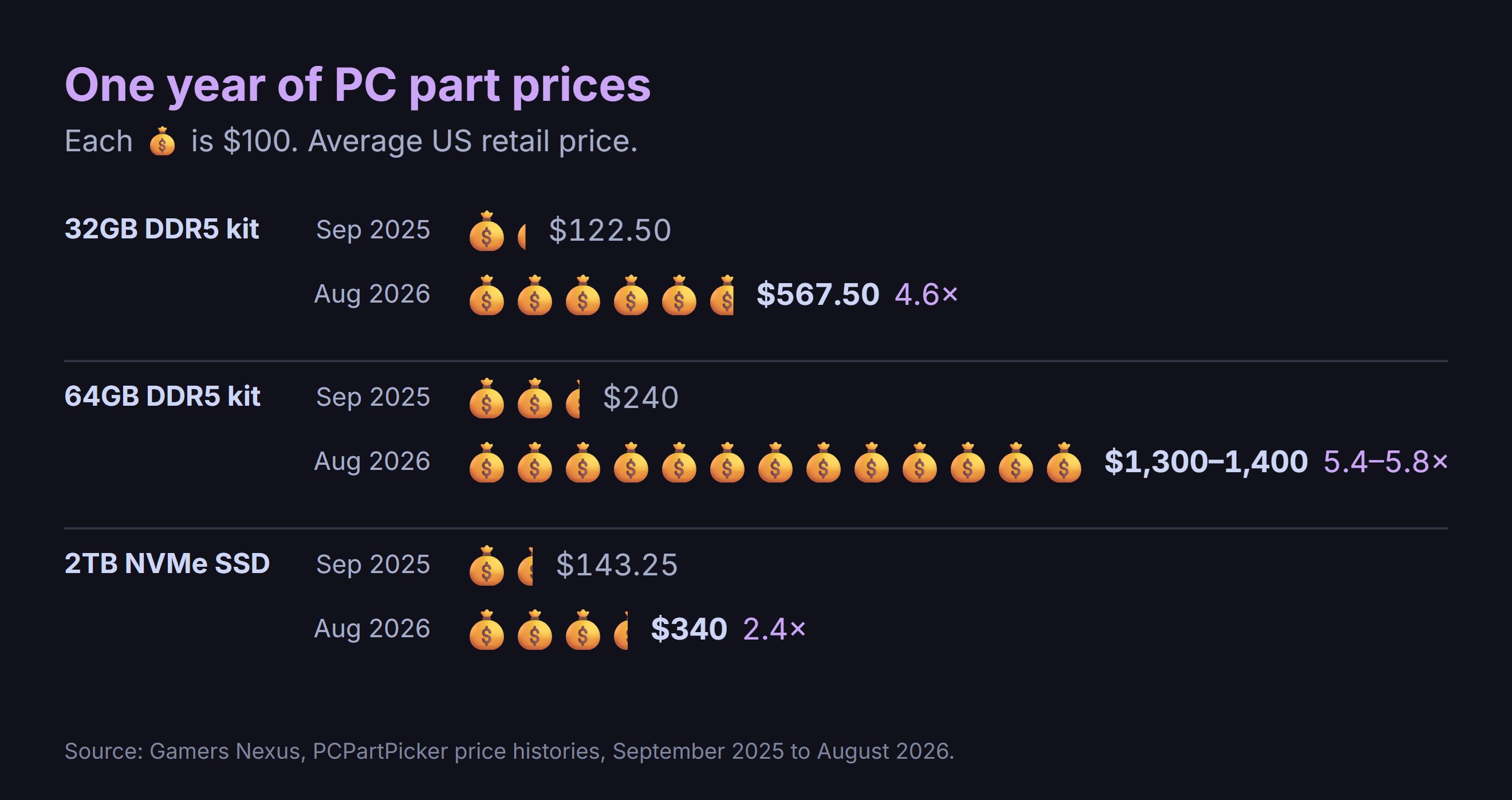
In the US, Gamers Nexus tracked a year of retail price histories and found the same story. The average 32GB DDR5-6000 kit went from $122.50 in September 2025 to $567.50 in August 2026. 64GB kits climbed from $240 to $1,300–$1,400.2
For 64GB, that's more than five times the price.
At these prices, upgrading your PC starts looking less like shopping and more like applying for a mortgage.
And it's not just RAM. The average 2TB NVMe SSD went from $143.25 to $340 over the same period,2 while graphics cards continue to face pricing and availability pressures.
So what's happening?
The AI industry has entered the room
AI infrastructure is consuming enormous amounts of computing capacity, memory, energy, and capital.
Memory manufacturers are moving production toward server DRAM and high-bandwidth memory.3 Enterprise SSDs are more profitable than consumer ones, cloud providers are locking in supply with long-term contracts, and higher prices are already weakening consumer demand.4
So consumers buy less because prices are too high, and suppliers don't mind, because they have more profitable customers elsewhere. It's a feedback loop, and gamers are not winning.
Why doesn't Nvidia just make more consumer GPUs? People clearly want gaming PCs, workstations, and hardware to run local AI.
Because demand isn't the only thing that matters. Opportunity cost matters.
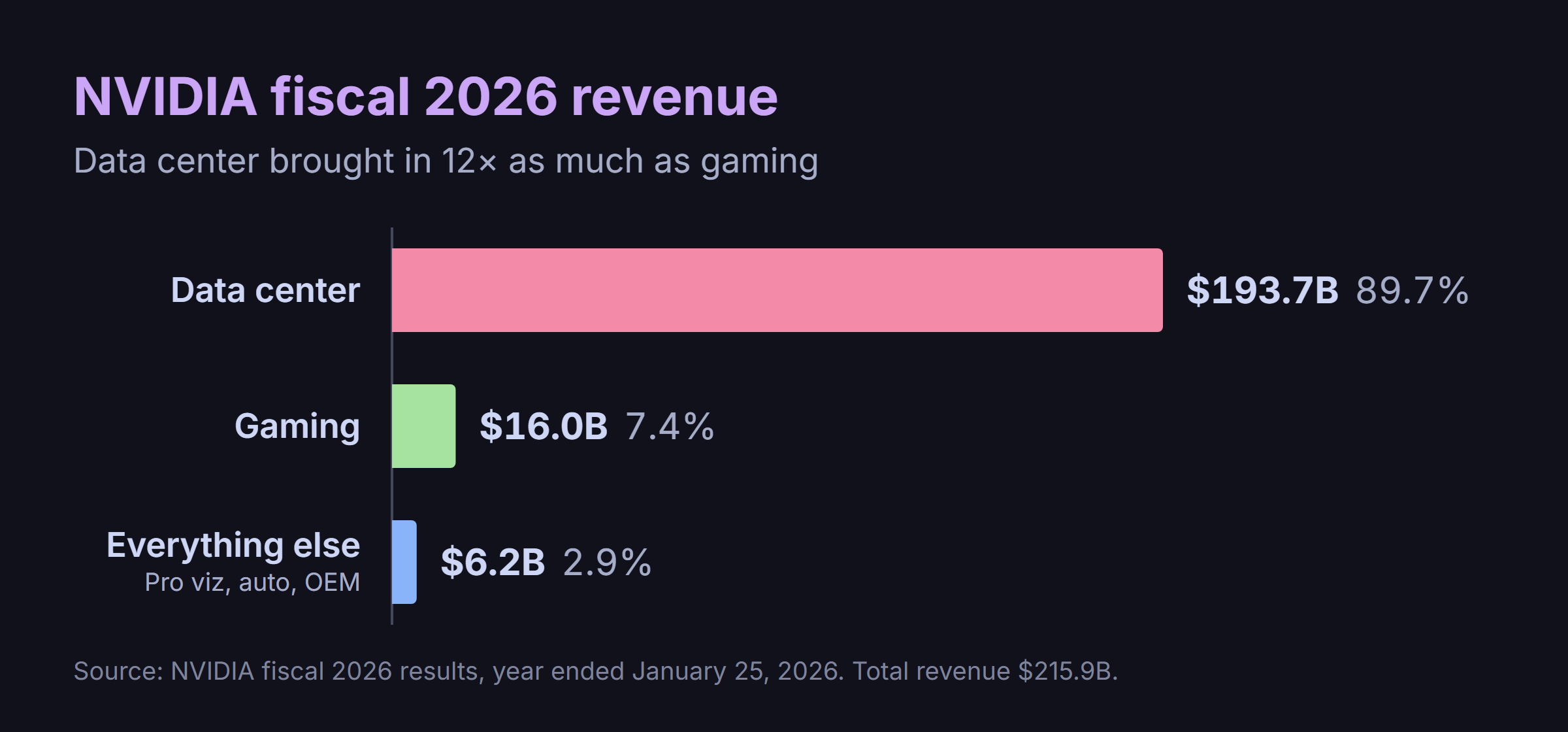
In its last fiscal year, data center brought in twelve times as much as gaming.5 The two don't use identical manufacturing resources, but they compete for the same investment, supply chain, and corporate attention.
So when capacity is tight, who gets served first? The gamer buying a graphics card every four years, or the company ordering thousands of accelerators? I think we know the answer.
Surely this can't go on forever?
Yes it can, and don't call me Shirley. 🤣 ('80s movie reference, let's goo!)
Yeah, but seriously, even though data centers are expanding rapidly, eventually there should be a turning point.
Manufacturing capacity will expand. Competing accelerators will improve. Inference will become more efficient. Cloud providers will compete on pricing.
The competition might bring prices down, but you should remember this important fact:
Frontier AI providers are not profitable, but data centers and hardware manufacturers are Extremely Profitable™ right now.
Unfortunately, the price surge will go on for a while. TrendForce expects SSD flash supply to loosen in the second half of 2027, but DRAM to stay tight until new fabs make a real difference in 2028.6
There's also the Jevons paradox: make something cheaper and more efficient, and people may use so much more of it that total demand increases.
If AI becomes ten times cheaper, companies might deploy a hundred times more agents. That's what hardware companies want. They believe we can solve most of our problems by just scaling up, more and more hardware, more power. UNLIMITED POWER... ahem.
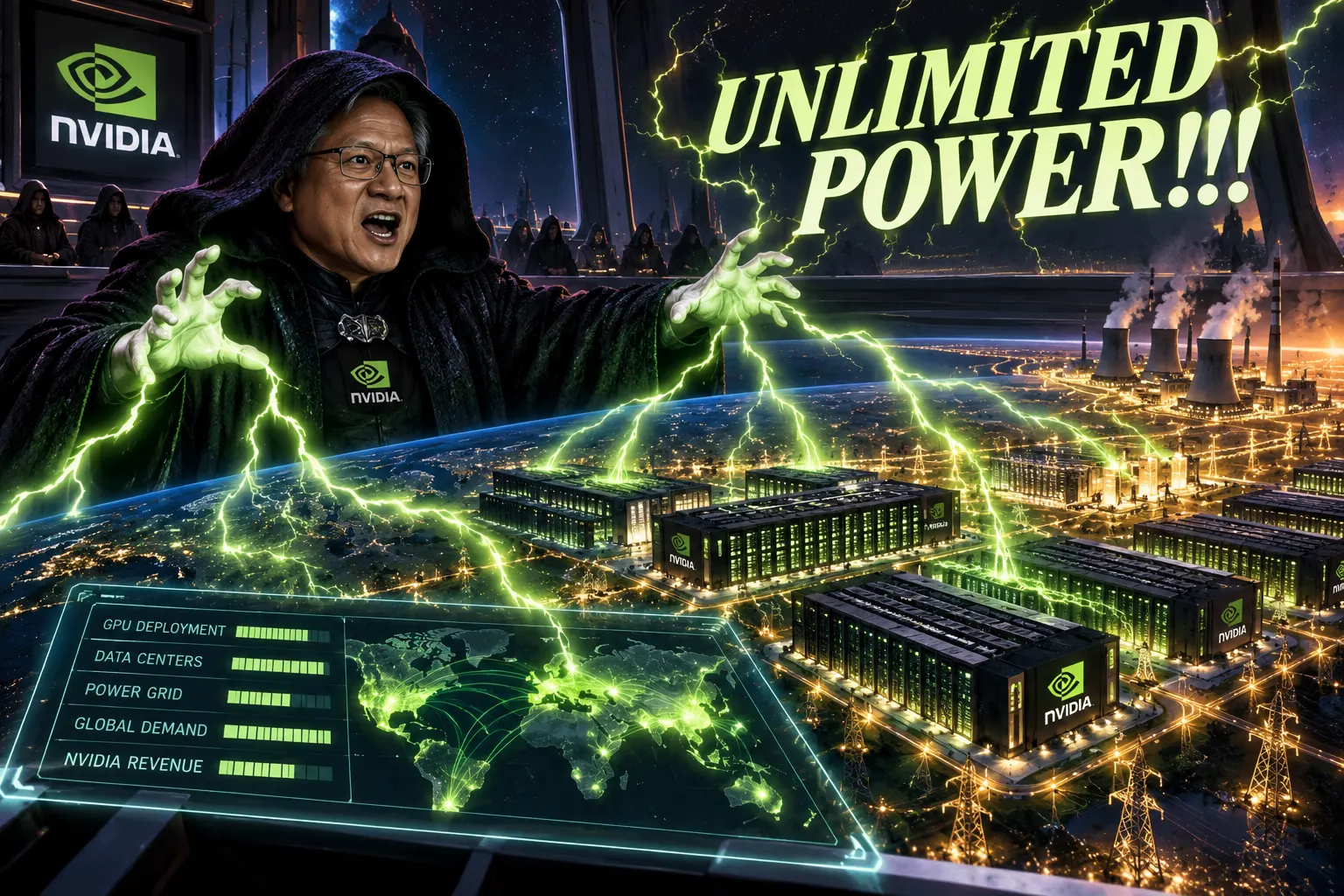
I hope I don't get sued 🥲
What could go wrong?
Nvidia's rise to the top wasn't just luck. It was an enormous amount of luck. 🤣
Gaming → crypto mining → AI infrastructure
CUDA is their biggest lever, and enterprise customers pay staggering amounts for it. But that dominance wasn't built by enterprise purchasing alone. It came from years of researchers, students, enthusiasts, and developers learning on Nvidia hardware they could afford.
So what happens when the next generation can't afford to experiment with it?
If they turn to AMD, Apple Silicon, other accelerators, or more portable inference frameworks, Nvidia could slowly lose one of its greatest advantages. CUDA isn't about to disappear, far from it. But squeezing the most revenue out of today's constrained supply isn't the same as winning the next decade of developers.
So, what's the deeeal?
Are we doomed? No, not yet at least. I believe there will be people who would take advantage of this, there's always someone who challenges and disrupts the market.
The open-source community and indie hardware hackers are working hard on finding an affordable way. And that is a good reminder of the power of the consumer, we are many, and when we get together we can do wild stuff. Remember GameStop?
We have MoE at home. Now we just need the RAM.
Footnotes
-
SweClockers, "DDR5-RAM" price focus, updated October 20, 2026. The index rose 399% in a year, from 115 to 572. ↩
-
Gamers Nexus, "Memory Companies Have Destroyed the Consumer Market", September 29, 2026. Averages of PCPartPicker listings with complete price histories, September 2025 to August 2026. ↩ ↩2
-
TrendForce, "Tight DRAM Supply Gives Suppliers Greater Pricing Power in HBM", June 2, 2026. HBM is expected to take 30% of DRAM wafer input in 2027, up from 18% in 2025. ↩
-
TrendForce, "AI Server Demand to Drive Memory Contract Price Increases in 2Q26", March 31, 2026. ↩
-
NVIDIA, "NVIDIA Announces Financial Results for Fourth Quarter and Fiscal 2026", February 25, 2026. Fiscal year ended January 25, 2026. "Everything else" is professional visualization ($3.2B), automotive ($2.3B) and the remaining $0.7B. ↩
-
TrendForce, "Diverging Memory Market Outlook in 2027", July 30, 2026. ↩